Project statement
When sound and image share the same internal weather
MIRA is not a visual accompaniment to a composition. It is a single audiovisual behaviour distributed between two environments.
A self-generating Krell patch in Max produces continually changing envelopes, pitches, timbres, densities and spatial positions. Those parameters travel to TouchDesigner, where they enter a visual engine based on mathematical formulas, equation mixing, flux points, palettes and spatial deformation. The image does not illustrate individual notes: it absorbs their energy and turns it into slow mutations, accumulating motion and immersive visual fields.
Audiovisual study
A system that never repeats itself
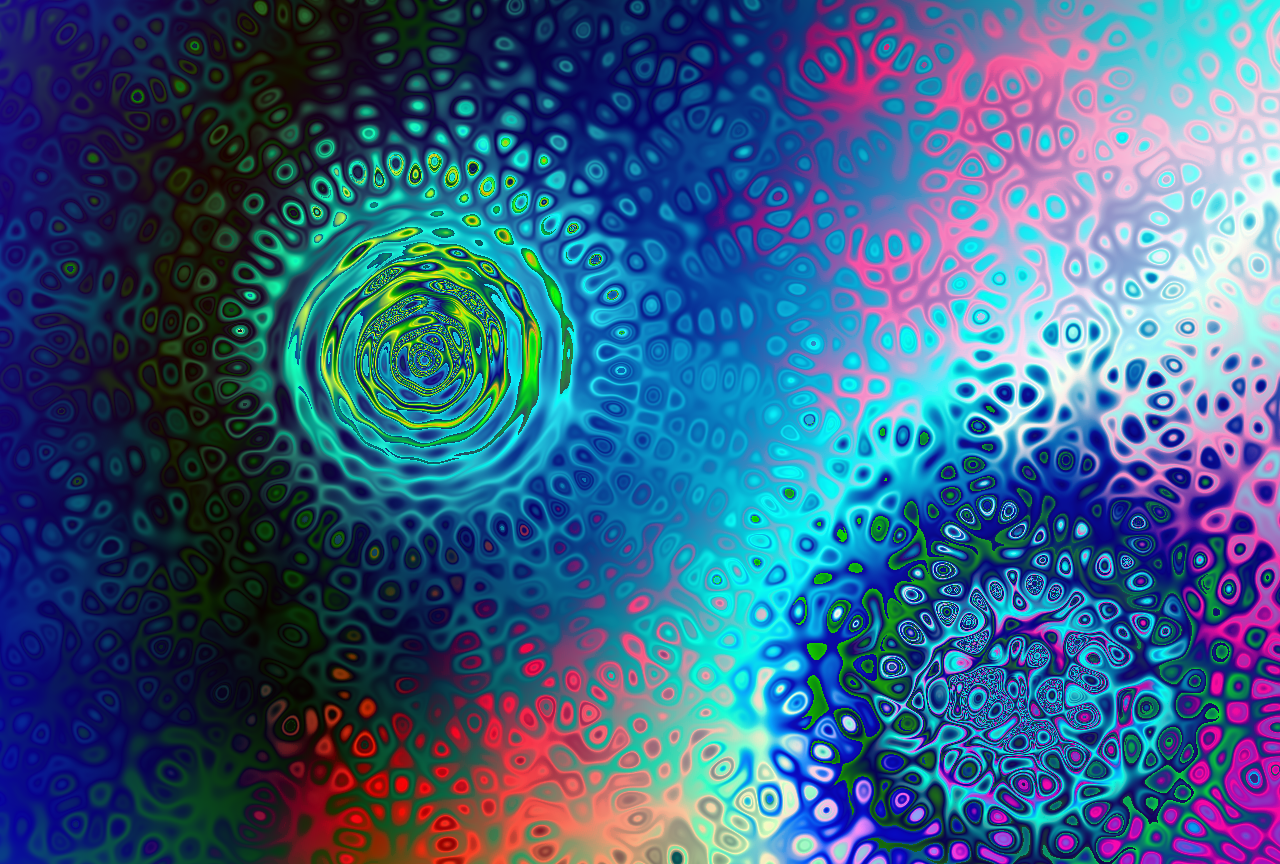
This recording documents the 164 configuration: a warped Tunnel and Quasicrystal field animated by the autonomous musical processes of the Krell patch.
System anatomy
A shared field of parameters
The relationship is designed as a set of musical correspondences rather than a generic amplitude-to-colour mapping.
Autonomous Krell voices
Independent envelopes continuously redraw attack, decay, silence, pitch, timbre, level and stereo position. With no common clock, the layers meet differently at every run.
Sound-to-image mapping
Envelopes, pitch, pan, brightness, density, mode and global level leave Max as smoothed control streams. Their motion opens vortices, moves flux points, changes cellular structures and bends the visual field.
Equation mixer
TouchDesigner combines different mathematical formula families through addition, difference, multiplication, XOR-like and warp relationships. The result is a mutable image space rather than a fixed effect chain.
Accumulation and ripples
Musical energy can advance the image instead of merely displacing it. Events leave visual memory; particle-like ripples expand from positions derived from the sound and gradually reshape colour and depth.
Image-to-sound return
In the bidirectional version, flux-point position, distance and palette sector can return to Max to influence pan, register, reverberation time and musical mode. Cause and response become deliberately ambiguous.
Performance continuity
Fast gestures, pitch trajectories and modal changes are smoothed at different rates. The system follows musical form without reducing every event to a visible trigger.
The most interesting moment is when it is no longer clear whether the image is listening to the sound or the sound is following the image.
MIRA grows from this uncertainty. I wanted the two systems to retain their own temporal character while sharing enough parameters to behave like parts of the same organism. Max supplies unstable musical life; TouchDesigner gives that life a spatial body made of formulas, colour, persistence and depth. The work is immersive because it does not aim at perfect synchronization. It aims at reciprocal influence.
- Refine the musical meaning of each audiovisual correspondence.
- Preserve smooth motion when Max is not the foreground application.
- Balance autonomous visual evolution with sound-driven intervention.
- Develop the bidirectional loop without producing unstable feedback.
- Adapt the system to projection and immersive display environments.
- Document repeatable startup, calibration and fallback states for performance.