Project statement
Software archaeology as a form of artistic listening
MOTH interests me as a visual instrument whose identity lies not in a fixed image, but in the tension between equations, colour and time.
The project begins with MOTH/MSP 1.0, a 2004 animated visual interference synthesizer by Kristopher Collins. Its Max patch fills an LCD surface with pixel data generated by two mathematical formulas. The performer selects and bends those formulas, mixes their results, constructs a palette and animates spatial control points through LFOs. My work approaches this historical patch first as an object to preserve in Max 8 and then as a system to rethink through TouchDesigner and GLSL.
Original output
Interference as visual material
The hero and the images below come from MOTH itself. They preserve the colour behaviour, radial tensions and fluid interference structures produced by the original equation engine rather than replacing them with newly generated artwork.
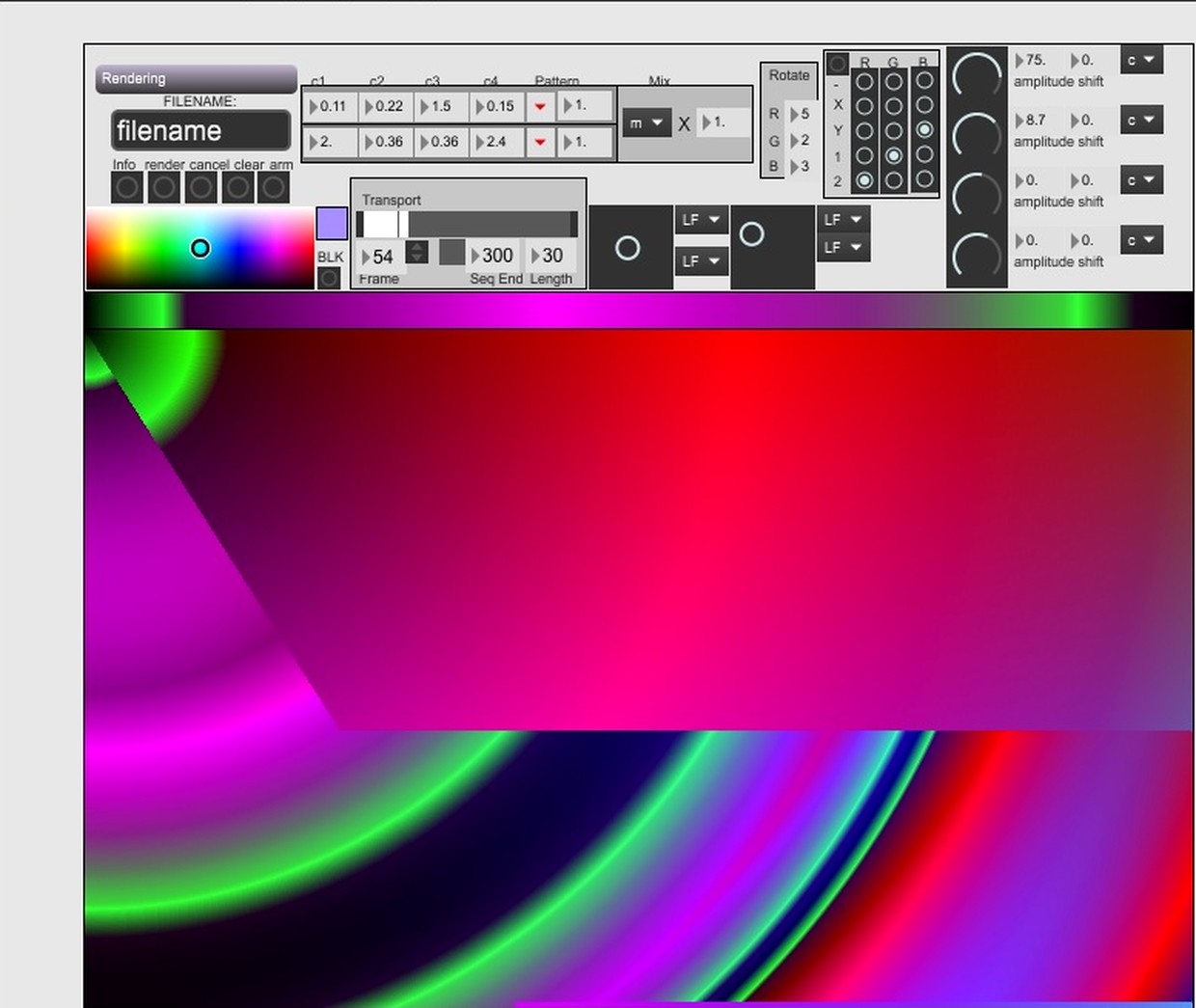
Max 8 preservation
Keeping the instrument playable
The first stage was a transparent port of the legacy Max patch. Eighteen patchers, their data tables, hidden connections and interface hierarchy were imported into Max 8 without redesigning the instrument.
The resulting archive contains 793 objects and 850 working connections. Compatibility work was limited to an isolated replacement for the historical for object, removal of three invalid symbolic routes and corrections that restore the full LFO range and both-axis movement.
Original MOTH/MSP 1.0 and manual: Kristopher Collins, 2004. Max 8 preservation and GLSL-oriented research: Pierluigi Vienna.
System anatomy
From equations to an animated image
The system is organised as an instrument rather than a collection of effects. A small group of parameters changes the mathematical conditions from which the complete frame emerges.
Formula pair
Two mathematical formulas generate the primary fields. Each formula has four tweak factors and a multiplier, allowing the performer to move continuously between recognisable states and unstable regions.
Equation mixer
The two fields can be combined through different mathematical relationships, including multiplication, addition and difference. The mixer determines how one structure interrupts, reinforces or erases the other.
Spatial control
Two movable flux points introduce local coordinates into the calculation. Their positions become compositional gestures rather than passive numerical inputs.
Palette construction
A user-built colour gradient maps the numeric field into chromatic space. Rotation and palette-skew functions make colour an active part of the synthesis process.
LFO movement
Four LFO sources can be assigned to the X and Y axes of the control points. The image becomes a temporal system whose motion grows from parameter trajectories.
Sequence rendering
Frame, sequence length and render controls turn the live patch into an animation instrument, connecting previewed behaviour with reproducible output.
GLSL translation
The porting study maps formulas to shader functions, tweak factors to uniforms, palettes to gradient sampling and LFO coordinates to normalised control channels, moving the image calculation from an LCD workflow toward a real-time GPU pipeline.
Porting an instrument is not only translating its code. It means deciding which gestures, limits and accidents still belong to its identity.
I do not want the GLSL version to become a generic shader that merely resembles MOTH. The essential question is how to preserve the relation between formula choice, spatial gesture, palette and duration while gaining the resolution and speed of a contemporary GPU environment. The historical constraints are part of the work: they reveal a mode of thinking about image synthesis that remains performative, compact and surprisingly open.
- Preserve the equation mixer as the conceptual centre of the instrument.
- Translate Max controls into resolution-independent shader uniforms.
- Keep palette creation performative rather than reducing it to presets.
- Maintain the relationship between flux points, LFOs and image structure.
- Use GPU resolution and speed without polishing away the early digital character.
- Document how software preservation can become a new artistic practice.