Project statement
Composition as movement between different listening scales
The patch treats every sample as a field of possible durations, textures and identities rather than as a finished sound.
Sampling Composer brings several transformation strategies into one Max/MSP environment. Chunking, scratching, grain processes, dyphon devices, wavetable and spectral transposition can work as distinct voices or as interacting layers. Random ramps, LFO-controlled levels, timeline triggers and improvisational playback make the patch both a compositional workspace and a performable instrument.
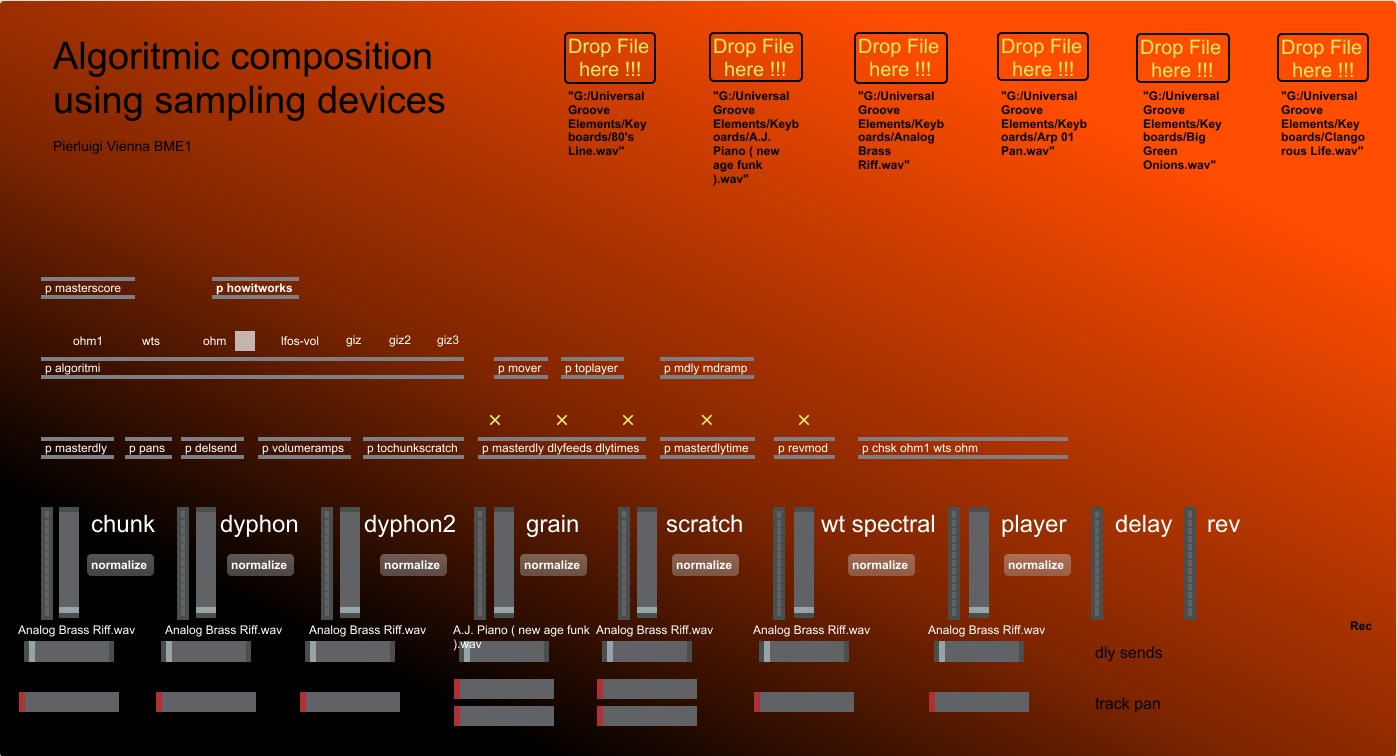
Patch interface
Many devices, one compositional surface
The interface keeps the source files, transformation voices, levels, sends and spatial controls visible at the same time. This makes the patch readable as a mixer and playable as an instrument.
Its arrangement also reveals the compositional idea: the same recordings can be redistributed across parallel devices, each observing a different temporal or spectral aspect of the material.
System anatomy
A family of transformations around shared sources
The environment combines complementary playback behaviours. Some preserve recognisable gestures, while others reduce the recording to fragments, grains or spectral material.
Source bank
Multiple recordings enter the system as reusable material. A source can remain identifiable or be distributed among several processes at once.
Chunk and scratch
Segment-based playback and directional movement expose local gestures, repetitions and discontinuities inside the sample.
Grain and dyphon voices
Short temporal units create densities and hybrid articulations that can move between texture, rhythm and unstable timbre.
Wavetable and spectral transposition
Wavetable treatment and pfft-based transposition shift attention from the original recording toward periodic and spectral behaviour.
Random ramps and LFO levels
Slow and fast control signals reshape the relative presence of each layer, creating continuous changes without rewriting the audio material.
Timeline and improvisation
Triggered events can articulate a planned form, while improvisational playback keeps the system open to immediate decisions and unexpected combinations.
From fragment to form
A single sample can operate as a recognisable phrase, a rhythmic cell, a granular cloud or a spectral colour. Moving between those scales lets form emerge from the material itself.
Automation without surrendering gesture
Algorithmic ramps and LFOs create motion, while the mixer, sends and playback choices keep the performer inside the decision process.
A recording does not contain one object. It contains many possible instruments, each appearing at a different scale of time.
The patch grew from my interest in making composition and sound transformation inseparable. I do not hear sampling only as quotation. A captured sound can be reopened, stretched into another body, fragmented into rhythm or reorganised into a texture whose origin remains present as a distant memory.
- How can several sampling models share material without collapsing into the same gesture?
- When does a fragment stop referring to its source and become a new instrument?
- How can automation create long-term form while remaining performable?
- What balance between timeline triggers and improvisation produces meaningful surprise?
- How can levels and sends become compositional parameters?
- Which parts of the system should remain visible to support musical decision-making?