Project statement
A particle becomes visible through the history of its decisions
This system begins with points, but its real material is movement: acceleration, resistance, confinement and the trace left behind.
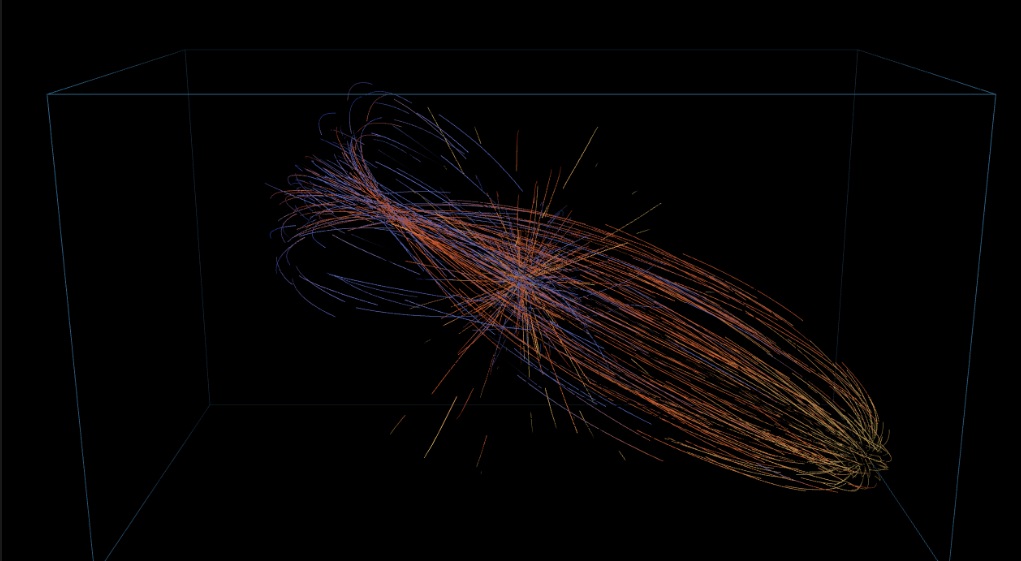
GLSL POP Particles is a GPU-oriented generator designed to move continuously between bounded and free behaviour. Emitters introduce matter into the scene; force fields bend, attract, repel or disturb it; bounds define an invisible architecture; trails expose the duration of every gesture. The system can produce restrained orbital structures, dense turbulent masses or long calligraphic lines that seem to search for a path through space.
System anatomy
A controllable field of moving matter
The generator separates emission, motion, constraint and visual memory. This makes the same structure usable as an autonomous study, an audio-reactive instrument or a component inside a larger audiovisual system.
Emitters
Position, direction, spread, density and initial velocity determine how particles enter the system and establish its first visual tendency.
Free and bounded modes
Particles may occupy open space or remain inside a defined volume. Bounds can contain, redirect or organise motion without becoming visible themselves.
Force field
Attraction, repulsion, directional forces, turbulence and drag combine to create behaviours ranging from precise flow to controlled instability.
Trails
Trail length and width turn instantaneous positions into temporal drawings. Motion becomes readable as continuity, rhythm and accumulated gesture.
Control surface
Exposed parameters allow fine adjustment of emitter behaviour, force intensity, spatial limits and trail rendering while the system is running.
Audiovisual use
Amplitude, spectrum, MIDI, OSC or other control signals can animate the field without changing its internal architecture, preserving a coherent visual identity.
A boundary does not simply stop movement. It gives movement a shape, a pressure and a reason to change.
I think of the system as a drawing instrument whose marks are never placed directly. Instead, I compose the conditions under which a line may appear: a force, a limit, a current, a delay. Trails reveal consequences. They make visible not only where a particle is, but how it arrived there and how long its gesture continues to inhabit the image.
- How do invisible limits become perceptible through movement?
- When does a simulation begin to function as a visual instrument?
- How can several forces remain legible without producing noise?
- What is gained when a trajectory is treated as memory rather than decoration?
- How can audio influence a field while preserving its autonomous motion?
- How can one control system move between delicate lines and dense particle masses?