Harmony processor / MIDI VST3
Twenty-five transformations, one performable harmonic system
Harmony Central transforms monophonic or polyphonic MIDI through a serial network of scale maps, transpositions and chord-aware voice-leading decisions.
The project began as a native Ableton Live MIDI Effect Rack created in 2022. Its twenty-five Scale devices have been translated into an independent Vienna Audio VST3 while preserving their order, original mappings and ability to operate simultaneously. The result is not a sound generator: it is a compositional layer placed before any MIDI instrument.
System anatomy
Harmony as a chain of choices
Each operator can be played as an independent harmonic action, combined with the others and recalled through the interface, MIDI notes or the computer keyboard.
Serial transformation network
Twenty-five operators reproduce the order of the original Live rack. Multiple operators can remain active, so the incoming material passes through every enabled map and transposition in sequence.
Source and Intelligent modes
Source mode follows the extracted mappings directly. Intelligent mode analyses the chord as a whole, keeps distinct voices where possible and balances the requested harmonic destination with continuity from the previous voicing.
Editable mapping matrix
Every operator exposes Base, a twelve-by-twelve pitch-class matrix, Transpose, Fold, Lowest and Range. Remapping and transposition can be used separately or together without collapsing them into a single tonal control.
Chord window and continuity
A zero-to-forty millisecond analysis window groups nearby attacks while preserving their timing and duration. Voice continuity can be adjusted to move from direct remapping toward more stable polyphonic trajectories.
Performance control
The twenty-five transformations can be switched from MIDI notes 0-24 or from an editable computer-key layout. Command filtering, channel selection, bypass and a dedicated note-release control keep performance routing explicit.
Live routing and state
Harmony Central is loaded on a MIDI track and routed to a receiving instrument track. Musical settings, matrices, assignments and operator states are stored with the host project for repeatable sessions and performances.
A harmonic instrument before the instrument
The system can reshape a chord, maintain a register across changing maps or accumulate several transformations into a less predictable harmonic field. Because it only generates MIDI, the same logic can conduct a piano, a modular texture, an ensemble or a distributed multichannel setup.
Deterministic musical decisions
The independent C++ engine uses fixed-capacity structures and performs no memory allocation during transformation. Note identity, sustain, overlapping notes, pitch bend, pressure, transport stops and state changes are handled without rewriting pitches already being held.
Reharmonisation becomes expressive when the system listens to the movement between voices, not only to isolated pitch classes.
Harmony Central treats harmony as a performable process. The original Scale network remains visible and editable, while the Intelligent mode adds a memory of the preceding voicing. I wanted the transition itself to become musical material: a chord is not simply corrected into a scale, but negotiated in relation to register, continuity and the direction of the phrase.
Interface view
Harmony Central 0.1.1
The editor exposes the complete operator network and the detailed mapping panel in a single resizable view.
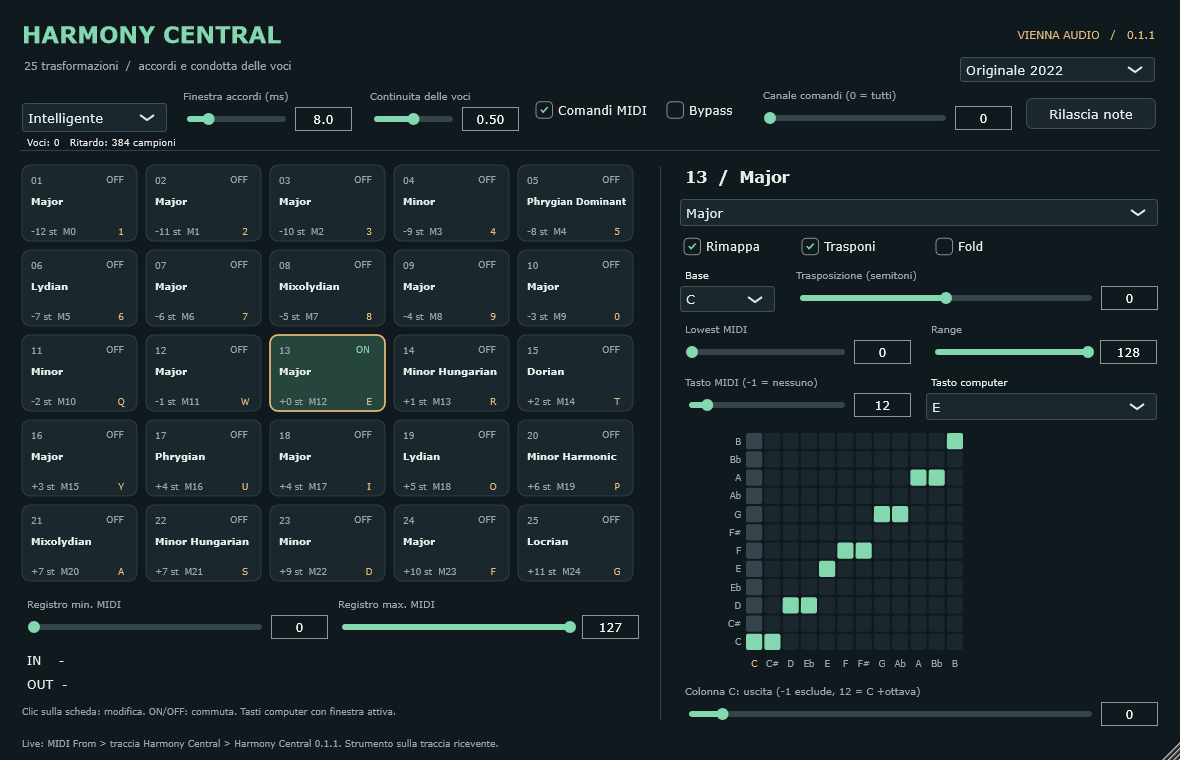
- Twenty-five serial scale and transposition operators.
- Source and chord-aware Intelligent processing modes.
- Editable pitch-class matrices and register controls.
- MIDI and computer-key performance assignments.
- Host-reported latency for the adjustable chord window.
- Validated VST3 scan, editor, MIDI input/output and state restoration.