Instrument statement
A waveform treated as a performable space
MODEL 601 is the central synthesis instrument of Vienna Audio: a complex generator designed to move continuously between stable waveform identities and more unstable, articulated spectral states.
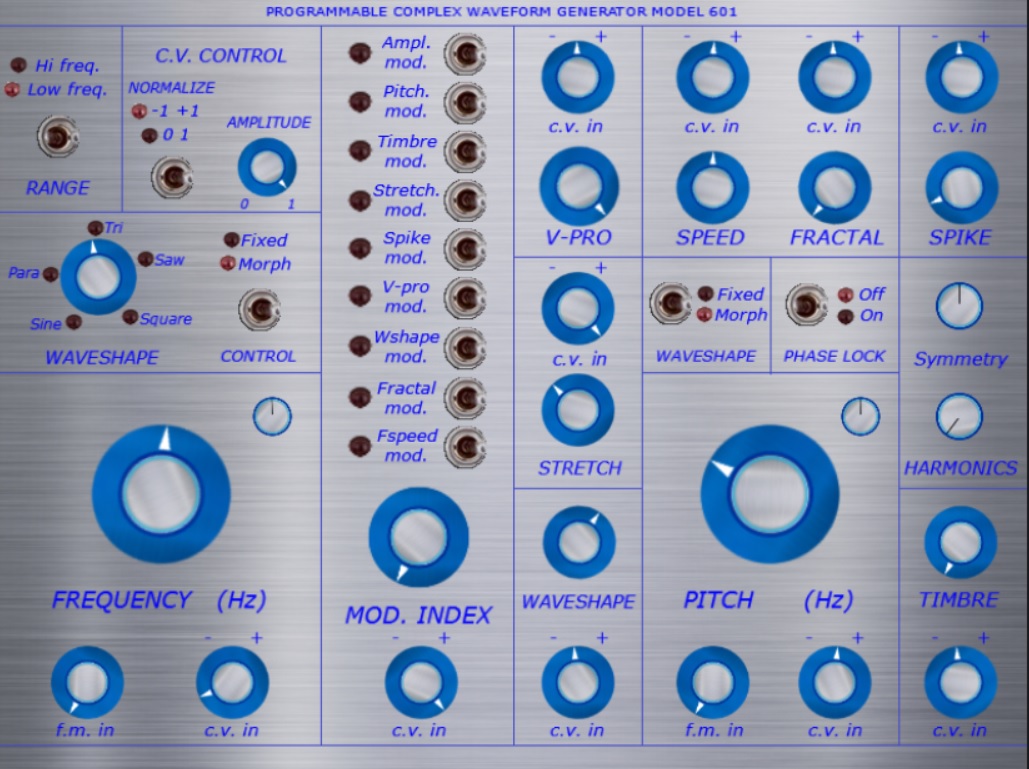
The instrument began as a TouchDesigner prototype, where sound generation, modulation and interface design could be developed together. Its architecture expands the idea of the complex oscillator through morphing waveshapes, V-PRO transformation, fractal motion, spike and stretch functions, harmonics, symmetry and a broad set of modulation inputs. The aim is not simply to offer many waveforms, but to make their internal transformation playable.
Instrument anatomy
From waveform selection to spectral behaviour
The panel groups pitch, waveform and transformation controls around a modulation structure in which most defining parameters can become dynamic rather than fixed.
Frequency and range
High and low frequency ranges, direct frequency control, pitch and dedicated FM/CV inputs allow the generator to operate as an audio oscillator or as a slower source of complex control movement.
Waveshape core
The source moves between sine, triangle, saw, square and parabolic families. Fixed and morphing modes turn waveform choice into either a stable state or a continuous trajectory.
V-PRO transformation
A central waveform can be pushed toward two processed extremes and every intermediate timbral state. This continuous path is designed as a primary performative gesture.
Stretch, spike and fractal
Stretch and spike reshape the waveform in contrasting ways, while fractal amount and speed introduce nested motion and detail. Each section has direct control and CV access.
Modulation matrix
Amplitude, pitch, timbre, stretch, spike, V-PRO, waveshape and fractal behaviour enter a shared modulation area with an overall modulation index for coordinated depth control.
Symmetry and harmonics
Phase lock, symmetry, harmonics and timbre parameters refine the relationship between waveform geometry and perceived spectrum, extending the instrument beyond conventional wavetable scanning.
From prototype to DSP instrument
TouchDesigner made it possible to prototype the signal flow and interface as one system. The same ideas are being translated into dedicated DSP structures, a hardware version and a 10-voice polyphonic VST3 implementation, preserving the relationships between modulation, waveform transformation and hands-on control.
One gesture, many timbral states
MODEL 601 is intended for evolving tones, animated drones, unstable basses, articulated leads and sound-design gestures in which a single movement can reorganise several dimensions of the spectrum without losing continuity.
I wanted the waveform to stop being a menu choice and become a material that could be pulled, folded and made unstable while it was sounding.
The instrument is deliberately placed between precision and excess. Its controls expose clear signal relationships, yet the modulation paths encourage combinations that are difficult to predict completely. That tension is the point: MODEL 601 should behave like an instrument whose identity becomes clearer through performance rather than through presets alone.
- TouchDesigner proof of concept for the original signal architecture.
- MODEL 601 hardware panel and control-surface research.
- Ten-voice polyphonic VST3 version.
- DSP translation of waveform and modulation functions.
- Reusable synthesis blocks for future Vienna Audio instruments.
- Integration with CV, MIDI and software control environments.