Instrument statement
Sequencing as a field of related voltages
MODEL 602 treats a sequence as more than a row of notes. Four parallel CV lanes allow pitch, timbre, dynamics and movement to be composed together while remaining independently scalable.
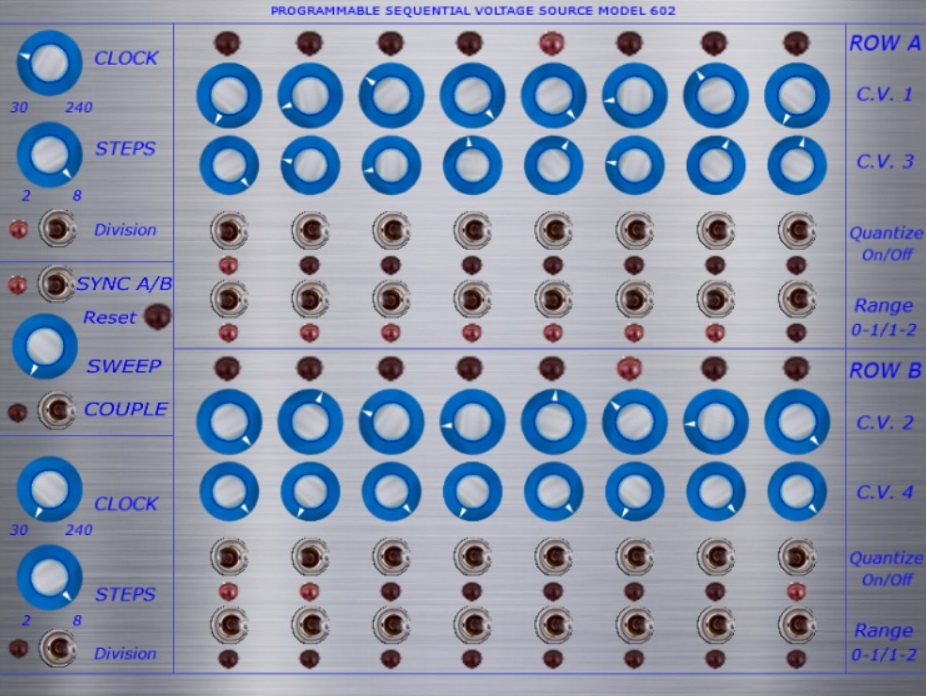
The instrument combines two clock and step-control sections with eight programmable stages and four voltage rows. The two banks can operate independently, synchronise, reset, sweep or become coupled. Quantisation and range controls allow the same pattern to move between melodic and continuous modulation roles.
Instrument anatomy
A sequence with several simultaneous meanings
Each stage can describe multiple control dimensions. Instead of repeating one contour, MODEL 602 lets several parameter stories advance through the same temporal structure.
Dual clock sections
Two clock controls establish independent rates for the upper and lower banks, allowing polyrhythmic movement or tightly synchronised operation.
Variable step count
Each bank can cycle through two to eight stages. Different sequence lengths produce shifting relationships without requiring randomisation.
Four CV rows
Rows CV1 to CV4 provide separate values at every stage. A single pulse structure can therefore coordinate pitch, filter movement, amplitude and any other destination.
Quantise and range
Quantisation switches and bipolar or unipolar ranges let each row move between stepped musical values and continuous control shapes.
Sync, reset and division
Clock division and reset functions define how the two banks enter, repeat and realign, making formal changes performable rather than fixed in advance.
Sweep and couple
Sweep changes the direction or scanning behaviour, while coupling links the banks into a larger coordinated system when independent loops are not required.
Timing without interface dependency
The original TouchDesigner network established the relationship between stage memory, clocking, row values and visual feedback. Translating the instrument into DSP means separating timing from the interface while preserving sample-accurate transitions, reset behaviour and predictable synchronisation.
Melody, gesture and form
MODEL 602 can produce conventional melodic patterns, but its larger purpose is coordinated control: several parameters can change together, diverge at different rates or create long composite cycles across a modular instrument.
A sequence becomes more musical when it can describe several dimensions of an event at the same time.
I designed MODEL 602 around the idea that repetition does not need to mean sameness. When four voltage rows share a stage structure, every repeated pulse can carry a different internal balance of pitch, colour and energy. Coupling and desynchronising the banks makes the instrument useful both as a precise composer and as a source of slowly changing form.
- Independent and coupled sequence banks.
- Four related CV streams from one temporal structure.
- Melodic or continuous modulation through selectable ranges.
- Clock division and variable-length pattern relationships.
- Reset and synchronisation for repeatable performance forms.
- DSP-ready timing and stage-memory architecture.