Instrument statement
Four curves that can become one larger gesture
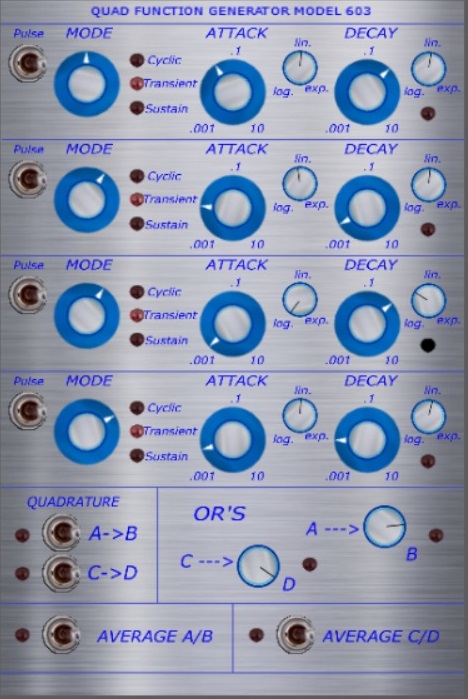
MODEL 603 is a quad function generator built for envelopes, cyclic movement and linked control structures. Each channel can operate independently, yet the lower section allows the four curves to produce compound behaviours.
Attack and decay times are continuously variable and their slopes can move between linear, logarithmic and exponential responses. Cyclic, transient and sustain modes let the same channel function as an envelope, an LFO-like source or a held control contour. Quadrature, OR and average outputs turn separate functions into a small modulation ecosystem.
Instrument anatomy
Control curves as compositional material
The module keeps the four generators visually and functionally consistent, making complex modulation possible without hiding the behaviour of each source.
Four independent channels
Each lane has its own pulse input, mode, attack and decay controls. The generators can therefore address unrelated destinations or act as parts of one composite gesture.
Attack and decay
Time ranges from short transient contours to slow movement. Independent attack and decay values create asymmetrical shapes suited to articulation, scanning and evolving control.
Curve response
Linear, logarithmic and exponential response controls alter how time is distributed inside each stage, changing both the musical feel and the spectral effect of a modulation.
Operating modes
Cyclic mode repeats the function, transient mode generates a single contour, and sustain mode holds a state before release. One circuit idea can therefore cover several modulation roles.
Quadrature links
A-to-B and C-to-D quadrature relationships create offset motion between paired generators, useful for stereo, spatial and phase-related control gestures.
OR and average outputs
OR combinations derive a changing contour from competing functions, while average A/B and C/D outputs create smoother composite voltages from each pair.
Curves independent from frame rate
In TouchDesigner the prototype made the control relationships immediately visible. The DSP translation focuses on time constants, retrigger behaviour, curve interpolation and stable output combinations so that the generators remain precise at audio or control rate.
Envelope, oscillator, movement
MODEL 603 can shape amplitude and timbre, produce repeating modulation, create staggered spatial movement or merge several contours into a single evolving control signal. Its value lies in using the same clear interface for both ordinary envelopes and less predictable structures.
A function generator becomes expressive when time, curvature and relationship can all be performed.
I see MODEL 603 as an instrument for organising motion. The individual curves are simple enough to understand by ear, but pairing, offsetting and combining them creates behaviours that feel larger than four envelopes. The module is especially useful when several parts of a sound need to breathe together without following exactly the same contour.
- Four independent attack-decay functions.
- Three operating modes for envelopes and cycles.
- Selectable curve response for musical timing.
- Quadrature relationships between channel pairs.
- OR outputs for emergent compound contours.
- Average outputs for smooth paired modulation.