Instrument statement
Filtering as movement between four spectral identities
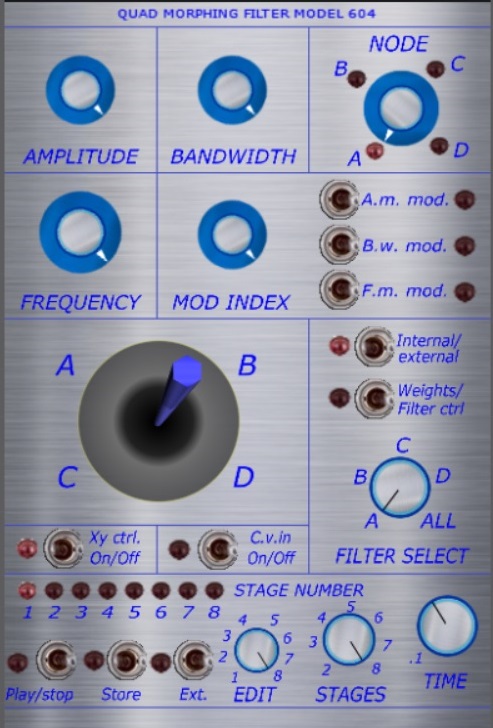
MODEL 604 is a quad morphing filter designed around continuous motion between four filter nodes. The sound is not routed through one fixed response: it travels across a field of spectral possibilities.
Amplitude, bandwidth, frequency and modulation index define the behaviour of the filter structure. A two-dimensional morphing control places the current sound between nodes A, B, C and D, while CV and external control can animate the same space. A programmable stage section stores positions and timing, turning manual movement into repeatable timbral trajectories.
Instrument anatomy
A filter that can remember a gesture
The interface separates spectral definition from spatial movement and stage memory, allowing the same four nodes to be explored manually, modulated or arranged into a timed sequence.
Four filter nodes
Nodes A, B, C and D define the corners of the morphing field. The current output can favour one node or occupy any intermediate balance.
Amplitude and bandwidth
Global amplitude and bandwidth controls establish the energy and width of the spectral response before or during movement across the four states.
Frequency and modulation index
Frequency positions the principal spectral action, while modulation index determines the depth of animated change applied to the filter behaviour.
XY morphing field
The central two-dimensional control turns filter selection into a continuous gesture. XY and CV switches determine whether that position is played manually or driven externally.
Internal and external control
Dedicated modulation inputs address amplitude, bandwidth and frequency. Internal/external and weights/filter-control switches define how the morphing system receives and distributes control.
Stage memory
Play, stop, store, external trigger, stage number, edit, stage count and time controls describe a programmable path through the filter field rather than a single static setting.
Interpolating without discontinuity
The TouchDesigner prototype made the four-node field and stage memory visible. The DSP version must preserve smooth interpolation between states, stable modulation depth and click-free movement while keeping stored trajectories synchronised and editable.
Draw the evolution of a spectrum
MODEL 604 can move a sustained sound through several spectral identities, animate rhythmically repeated material, create spatially perceived timbral gestures or store longer filter sequences that become part of a composition.
The filter is not only a response curve. It can be a path, a memory and a choreography of spectral states.
The artistic centre of MODEL 604 is the XY field. It makes timbre feel spatial: moving through the interface becomes analogous to crossing a landscape whose corners have different spectral identities. The stage editor then allows that gesture to be remembered, repeated and transformed without reducing it to a conventional preset change.
- Continuous interpolation between four filter nodes.
- Manual XY performance and CV-driven movement.
- Independent modulation of amplitude, bandwidth and frequency.
- Selectable control distribution across the filter structure.
- Stored multi-stage trajectories with editable timing.
- DSP translation focused on smooth, click-free morphing.