Instrument statement
Four independent clocks for a field of movement
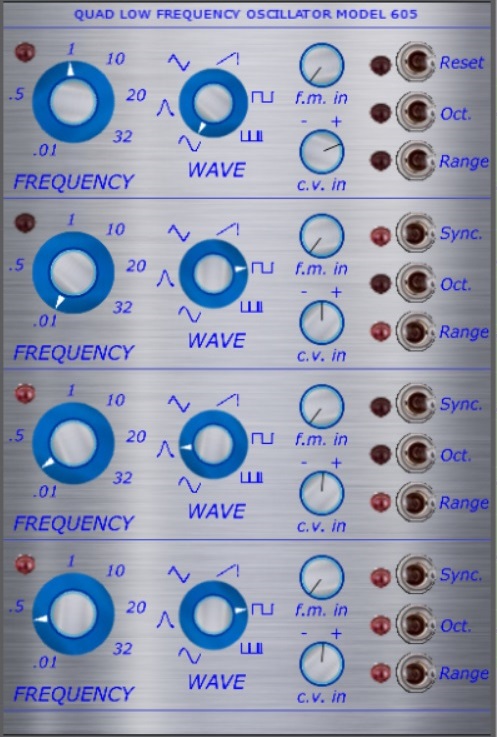
MODEL 605 is a quad low-frequency oscillator conceived as a compact source of parallel modulation. Four related lanes can behave independently or become part of one coordinated temporal structure.
Each lane combines frequency, waveform selection, frequency-modulation input and bipolar CV control. Reset or synchronisation, octave switching and range selection extend the relationship between free-running gestures and clocked behaviour. The module can produce four subtle drifts, four contrasting rhythmic shapes or a layered family of movements derived from the same control idea.
Instrument anatomy
Modulation as layered time
The four repeated strips make temporal relationships immediately visible. Each strip is complete, while shared interface logic encourages the performer to read all four as a single modulation instrument.
Four oscillator lanes
Each lane generates its own low-frequency signal, allowing unrelated rates or carefully tuned ratios to coexist in the same patch.
Wide frequency control
The frequency control moves from very slow cycles toward faster modulation. Range and octave switches reposition the useful interval without changing the panel logic.
Wave selection
The waveform selector offers several rising, falling, curved and stepped profiles. Changing shape alters not only the signal but the perceived gesture applied to a destination.
Frequency modulation input
A dedicated FM input introduces variation into each lane's rate, useful for irregular pulsation, nested modulation and evolving rhythmic relationships.
Bipolar CV response
The CV input applies positive or negative influence to the oscillator. This makes direction and depth part of the performance rather than a fixed routing decision.
Reset and synchronisation
The first lane exposes reset while the following lanes offer synchronisation, supporting aligned starts, linked phases and repeatable compound gestures.
Stable timing across four modulated phases
The DSP implementation must preserve phase continuity while frequency and CV values change. Reset and sync events need deterministic behaviour, and range changes should remain musically controlled without discontinuities at the outputs.
Compose with movement before sound
MODEL 605 can animate filter frequencies, wavetable positions, spatial parameters, amplitudes or visual systems. Four lanes make it possible to compose a family of motions before deciding which sonic or visual parameters will receive them.
A modulation source can be more than a utility: four related cycles become a small composition of time.
MODEL 605 treats periodic motion as musical material. The repetition of the interface is deliberate: it gives every lane the same status while inviting differences in rate, profile and synchronisation. The result can remain almost imperceptible or become the rhythmic architecture of an entire patch.
- Four independent low-frequency modulation lanes.
- Several wave profiles for distinct gesture shapes.
- Per-lane frequency modulation and bipolar CV control.
- Range and octave switching for multiple time scales.
- Reset and synchronisation for repeatable relationships.
- DSP translation focused on phase stability and smooth control.