Instrument statement
Four voices between waveform and spectrum
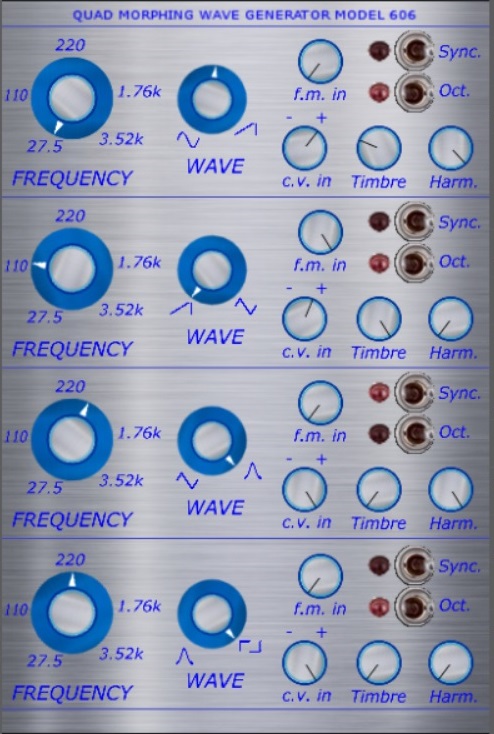
MODEL 606 is a quad morphing wave generator in which waveform, timbre and harmonic content remain available as continuous musical dimensions across four parallel voices.
Every lane combines a broad frequency control with waveform selection, FM and CV inputs, timbre, harmonic shaping, synchronisation and octave switching. The repeated architecture supports dense tuned structures, related modulation voices or four independent signal sources whose internal shapes can evolve over time.
Sync makes it possible to establish phase and timing relationships between the voices, transforming four parallel generators into an interconnected synthesis structure. Octave selection reorganises their register and frequency proportions, opening particularly interesting possibilities for harmonic control, composite waveforms and coordinated modulation.
Instrument anatomy
A repeated structure for evolving tone
Each voice follows the same control grammar, so attention can move from isolated sound design to relationships between frequencies, phases and spectral identities.
Four generator voices
The four lanes can form a composite oscillator, a chordal structure, a bank of related modulators or independent sources distributed through a larger system.
Frequency and octave
A wide frequency dial establishes the fundamental region while octave switching quickly reorganises register and proportional relationships between voices.
Waveform morphing
The wave control moves among contrasting profiles. Intermediate positions allow the source to be treated as a continuum rather than a menu of fixed oscillator shapes.
FM and bipolar CV
Frequency-modulation and CV inputs add external movement. Their dedicated attenuators make subtle inflection and strongly animated behaviour equally accessible.
Timbre and harmonics
Timbre and harmonic controls alter the internal spectral character after the basic waveform has been selected, extending each voice beyond conventional shape selection.
Voice synchronisation
Per-lane sync controls support phase-related structures and repeatable transients while still allowing the four generators to separate when freer motion is needed.
Morphing without spectral jumps
The DSP path must keep waveform transitions smooth under audio-rate or control-rate movement. Frequency, FM, timbre and harmonic stages require stable interpolation and careful level management across all four voices.
Build one sound from four identities
MODEL 606 can form animated drones, tuned clusters, interlocked modulation sources or a complex composite oscillator. Small differences between lanes create beating and depth; synchronised settings produce focused and repeatable structures.
The instrument begins with four voices, but its real subject is the space of relationships that opens between them.
MODEL 606 extends the idea of waveform selection into a performable spectral field. Repeating the same controls four times creates clarity, yet the combined result can become highly complex. The performer can hear each lane as an individual voice or treat the bank as one organism whose internal parts move at different speeds.
- Four parallel morphing waveform generators.
- Wide frequency and octave organisation.
- Independent FM and bipolar CV control.
- Timbre and harmonic shaping for every voice.
- Synchronised or free-running oscillator relationships.
- DSP translation focused on smooth spectral interpolation.