Instrument statement
Mixing as a continuous performance gesture
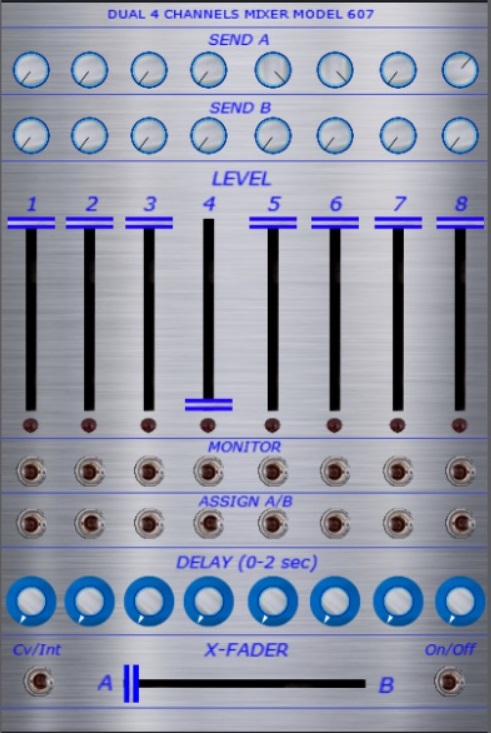
MODEL 607 is an eight-channel mixer organised around two destination buses. It combines level control, dual sends, channel monitoring, A/B assignment, individual delay times and a final crossfader.
The module is designed for movement between parallel states rather than static summing alone. Eight sources can be distributed toward bus A or B, monitored independently and given separate send values. Delay controls introduce temporal displacement before the two resulting scenes are traversed with a manual or CV-controlled crossfade.
Instrument anatomy
Eight channels, two scenes, one trajectory
The interface moves vertically from distribution to level, monitoring, bus assignment, delay and final performance control. Routing decisions remain visible as part of the instrument.
Eight input channels
Eight vertical channels accommodate a compact ensemble of oscillators, processed signals or external sources while retaining individual control over each contribution.
Dual sends
Send A and Send B provide two independent values per channel, allowing the same source to participate differently in parallel processing or destination structures.
Channel levels
Long faders establish the primary balance. Their central placement makes amplitude relationships readable before routing and time-based transformation are applied.
Monitor and A/B assignment
Dedicated monitor points support inspection of individual channels, while assignment controls determine how each source contributes to the two output states.
Per-channel delay
Eight delay controls, labelled from zero to two seconds, turn the mixer into a temporal distributor capable of echoes, offsets and staged entrances.
CV-enabled crossfader
The final A/B crossfader moves continuously between the two scenes. CV/internal selection and on/off control allow this movement to be played manually or animated.
Routing without clicks or level surprises
The DSP version must combine eight channels, two send structures and per-channel delays with controlled gain staging. Assignment and crossfader changes require smoothing, while the delay paths need stable interpolation under continuous control.
Move through two versions of the same material
MODEL 607 can crossfade between dry and transformed scenes, distribute eight voices across parallel chains, create rhythmic offsets or turn a collection of signals into a continuously changing performance mix.
The mixer becomes an instrument when routing, time and transition can be performed as one gesture.
MODEL 607 treats the space between bus A and bus B as compositional material. The channels do not merely arrive at an output: they are assigned, delayed and recombined into two possible scenes. The crossfader makes the passage between those scenes audible, controllable and repeatable.
- Eight channels with individual level control.
- Two independent send values per channel.
- Monitoring and explicit A/B routing.
- Per-channel temporal displacement up to two seconds.
- Manual or CV-controlled crossfade between buses.
- DSP translation with smoothed routing and delay control.