Instrument statement
Reshaping the behaviour of control signals
MODEL 608 is a four-channel dynamics manager for control voltages. It is designed to transform how modulation moves, responds and settles rather than simply changing its amplitude.
Four CV lanes pass through individual response positions, bandwidth controls, selectable operating modes and low-pass or high-pass behaviour. The module can smooth abrupt control, isolate faster motion, combine filtering with gated response or give four related signals different dynamic personalities before they reach their destinations.
Instrument anatomy
Four ways of giving motion a new character
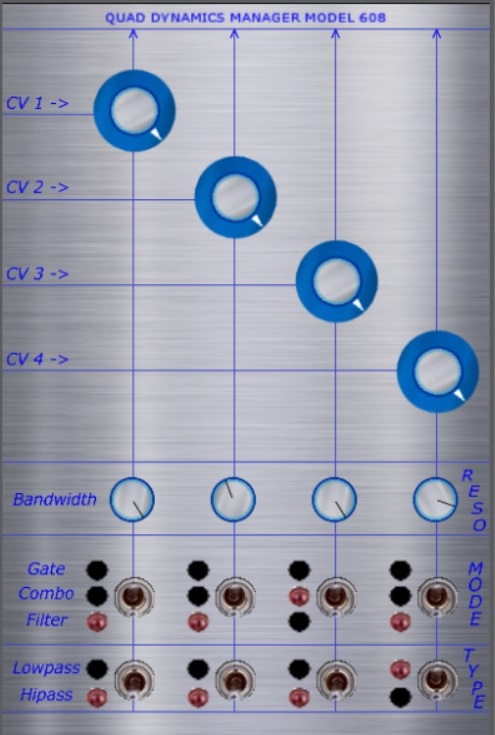
The vertical signal paths make the transformation of each CV lane explicit: a primary response position leads into bandwidth, mode and filter-type choices.
Four CV paths
CV inputs 1–4 are processed independently, allowing one modulation family to be split into differentiated behaviours or four unrelated signals to be conditioned together.
Response position
The large controls define the principal response of each lane. Their placement along vertical paths makes the relative state of all four channels readable at a glance.
Bandwidth
Per-channel bandwidth control determines how much temporal or spectral movement is retained, opening a continuum between broad gesture and restricted variation.
Gate mode
Gate mode favours a more discrete response, useful when a continuous control source needs to produce events, thresholds or clearly articulated state changes.
Combo and filter modes
Combo and filter selections offer alternative response structures, making it possible to combine dynamic behaviour with direct signal conditioning.
Low-pass and high-pass type
Each channel can favour slow, smoothed motion or emphasise faster changes. The choice defines whether continuity or transition becomes the dominant material.
Control-rate filtering with predictable response
The DSP design must define stable low-pass and high-pass responses for control signals, preserve independent bandwidth settings and manage mode changes without abrupt jumps. Clear scaling is essential because the outputs may drive sensitive synthesis parameters.
Turn raw modulation into phrased gesture
MODEL 608 can soften sequencer steps, recover accents from continuous motion, generate contrasting responses from related CV sources or prepare four expressive control streams for synthesis, spatialisation and audiovisual mapping.
Control signals have articulation, weight and inertia; shaping those qualities is already an act of composition.
MODEL 608 focuses on the behaviour that sits between a source and its destination. A raw gesture rarely needs to arrive unchanged. By filtering its motion, selecting a response mode and treating four lanes independently, the module turns modulation conditioning into a visible and performable stage of instrument design.
- Four independent control-voltage processing paths.
- Per-channel response and bandwidth control.
- Gate, combo and filter operating modes.
- Low-pass treatment for smoother modulation.
- High-pass treatment for transitions and accents.
- DSP translation centred on stable, predictable control scaling.