Instrument statement
Two waveforms in continuous transformation
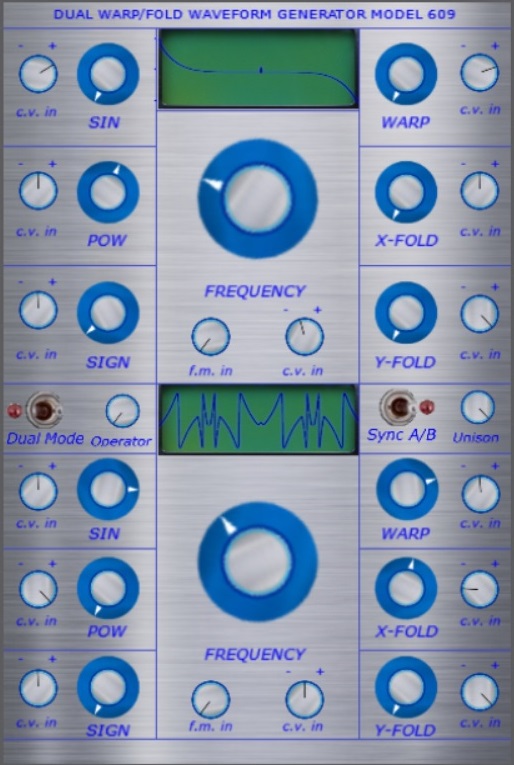
MODEL 609 is a dual morphing wavetable generator built around two visible waveform paths. Each generator can move from a basic table into increasingly folded, warped and asymmetric shapes.
The two sections combine frequency, FM and CV control with sine, power and sign shaping on one side and warp, X-fold and Y-fold on the other. Waveform displays keep the transformation visible, while dual mode, synchronisation and unison controls establish relationships between generators A and B.
Instrument anatomy
A visible path from table to complex spectrum
The mirrored architecture allows the two generators to be programmed independently and then joined through synchronisation, unison or dual-operation behaviour.
Two wavetable generators
Generators A and B each have their own frequency and transformation controls, supporting layered tones, interacting voices or a single composite source.
Waveform displays
The displays make the current table legible while it changes. Visual feedback turns complex shaping into a direct relationship between gesture, geometry and sound.
Sine, power and sign
Three shaping stages alter curvature, concentration and polarity structure. Each has its own CV input so the internal geometry can remain in motion.
Warp and two-axis fold
Warp displaces the table while X-fold and Y-fold introduce additional repetitions and reflections. Their CV inputs make spectral density dynamically controllable.
Frequency, FM and CV
Independent frequency controls define the two registers, with FM and bipolar CV paths available for vibrato, modulation, cross-related motion and audio-rate interaction.
Dual relation controls
Dual Mode Operator, Sync A/B and Unison determine how the two generators behave together, from parallel independence to more tightly related composite synthesis.
Continuous table shaping under modulation
The DSP version must interpolate tables and shaping parameters without discontinuities. Fold stages, FM, synchronisation and unison need controlled amplitude and alias-aware behaviour when modulation becomes fast or geometrically extreme.
Move between contour and texture
MODEL 609 can produce evolving basses, unstable metallic spectra, animated drones and paired voices whose internal geometry is continuously rewritten. Slow CV reveals gradual morphing; faster control turns the same architecture into a dense spectral instrument.
The waveform is not a fixed source but a surface that can be bent, folded and placed in dialogue with another surface.
MODEL 609 grows from the idea that sound design can remain visually understandable even when its spectrum becomes complex. The displays are not decoration: they allow the performer to recognise the evolving geometry and to connect the shape of a gesture with its sonic consequence.
- Two independent morphing wavetable generators.
- Visible waveform feedback for both signal paths.
- Multi-stage shaping through sine, power, sign and warp.
- Independent X-fold and Y-fold transformation.
- Sync, unison and dual-operation relationships.
- DSP translation focused on smooth, controlled spectral motion.