Instrument statement
Composing a waveform through 120 partials
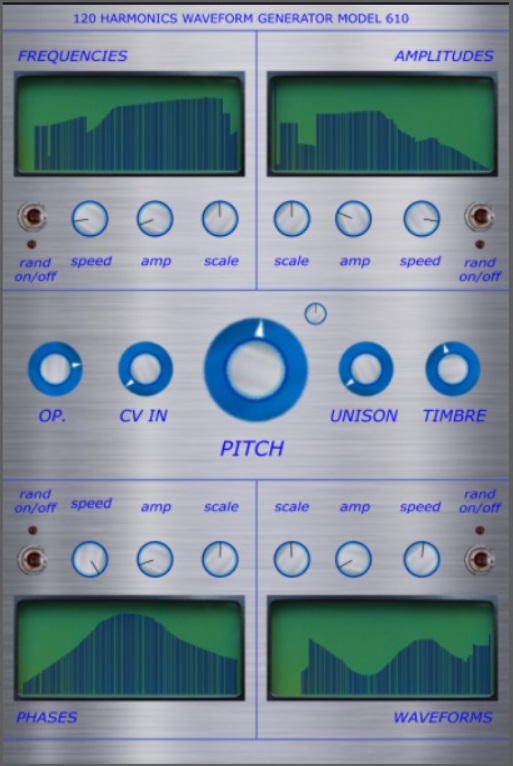
MODEL 610 is a harmonic waveform generator that exposes the frequency, amplitude, phase and waveform organisation of 120 components as four related distributions.
Four displays reveal how the partial bank is structured. Each distribution has scale, amplitude and speed controls together with random activation, allowing stable spectra and constantly evolving configurations. Global pitch, unison, timbre, operator and CV controls transform the harmonic field as a coherent instrument.
Instrument anatomy
Four maps of one complex sound
The generator separates harmonic organisation into visible layers. Each layer can remain stable or acquire its own speed, scale and degree of random variation.
Frequency distribution
The frequency map defines the placement of partials across the spectrum, moving the instrument between harmonic alignment and more dispersed relationships.
Amplitude distribution
The amplitude map establishes the weight of each component and therefore the spectral contour, brightness and perceived focus of the resulting waveform.
Phase distribution
Independent phase organisation changes the temporal alignment of the partials, affecting waveform geometry and the transient identity of the combined signal.
Waveform distribution
The fourth map determines the waveform character assigned across the harmonic bank, extending additive construction beyond a uniform set of sine partials.
Animated distributions
Scale, amplitude, speed and random switches can animate each map independently, turning a fixed spectrum into a multi-dimensional evolving structure.
Global voice controls
Pitch, CV input, operator, unison and timbre controls reshape the complete bank, providing performable access to a system that remains detailed internally.
Managing a dense partial bank efficiently
A DSP implementation must update 120 components without compromising real-time performance. Parameter changes require smoothing, random processes need bounded behaviour, and level normalisation must prevent energy growth as distributions become denser.
Design spectra as living structures
MODEL 610 can generate organ-like stability, shifting metallic clouds, dense electroacoustic textures and timbres that move between harmonic and inharmonic organisation. Its four maps make long-form spectral evolution directly composable.
A complex sound can be approached as four simultaneous drawings: where its components are, how strong they are, when they align and what shapes they carry.
MODEL 610 makes additive thinking spatial and visual. Instead of editing 120 isolated values, the performer acts on distributions whose motion remains perceptible as a larger form. The interface allows microscopic spectral construction to become a macroscopic musical gesture.
- Waveform construction from 120 harmonic components.
- Independent frequency, amplitude, phase and waveform maps.
- Animated distributions with speed and scale control.
- Optional random evolution for every domain.
- Global pitch, unison, timbre and CV interaction.
- DSP optimisation and level management for dense spectra.