Instrument statement
Translating performance data into an open control field
MODEL 611 is a four-channel MIDI-to-CV decoder that separates note events, expression and continuous controllers into individually addressable control signals.
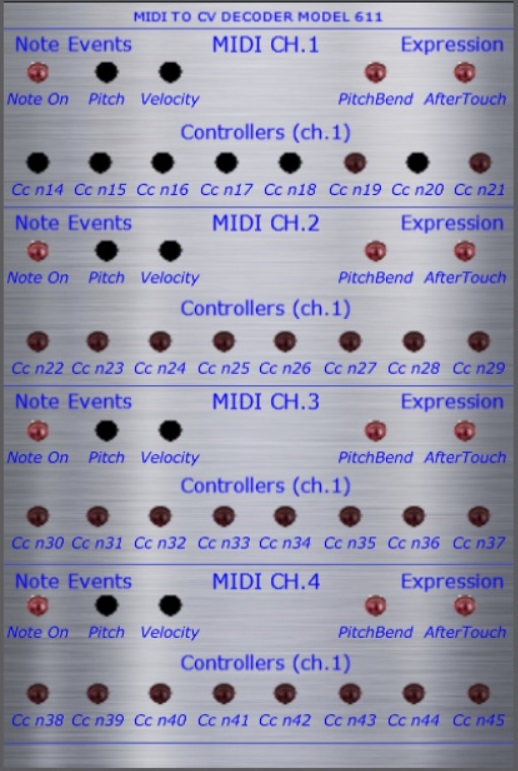
Each MIDI channel exposes note-on state, pitch and velocity alongside pitch bend, aftertouch and a dedicated bank of controller values. The module turns keyboard, controller and sequencer data into a structured interface for hybrid instruments, modular synthesis and audiovisual systems.
Instrument anatomy
Four complete paths from gesture to voltage
The interface repeats the same decoding structure for four channels, making complex MIDI routing visible and preserving the identity of each incoming performance stream.
Four MIDI channels
Channels 1–4 are decoded in parallel, supporting multitimbral control, independent performers, split-keyboard structures or four coordinated voices.
Note-on events
Note-on information becomes an explicit gate-like state that can trigger envelopes, events, scene changes or visual actions elsewhere in the system.
Pitch and velocity
Pitch provides note position while velocity carries the force of the event, preserving both selection and articulation as separate control dimensions.
Pitch bend
Pitch-bend data supports continuous deviation around quantised notes and can also be redirected toward any parameter that benefits from a centred expressive gesture.
Aftertouch
Aftertouch extends the note after its attack, allowing sustained pressure to shape timbre, amplitude, spatial movement or visual intensity.
Controller banks
Eight continuous-controller outputs per channel expose an extended performance surface for macros, synthesis parameters and cross-platform control mappings.
Reliable data with musical scaling
The implementation must parse channelised MIDI deterministically, distinguish event and continuous data, and scale outputs to predictable ranges. Controller smoothing is useful where discrete MIDI values drive sensitive synthesis parameters.
One performance, many destinations
MODEL 611 can control four synthesiser voices, distribute expressive data to audio and image simultaneously, connect Ableton Live or hardware controllers to Vienna Audio instruments, and transform conventional MIDI gestures into a wider modular vocabulary.
Interoperability becomes musical when translation preserves the nuance of the original gesture.
MODEL 611 is less concerned with MIDI as a protocol than with what remains after the protocol is opened. Note, pressure, velocity and controller movement become independent materials that can be recombined freely across synthesis, spatialisation and audiovisual interaction.
- Parallel decoding of four MIDI channels.
- Separate note-on, pitch and velocity outputs.
- Pitch-bend and aftertouch expression paths.
- Eight controller outputs for every channel.
- Hybrid audio, hardware and audiovisual mapping.
- Predictable scaling and smoothing for continuous control.