Instrument statement
Extracting gesture from the energy of sound
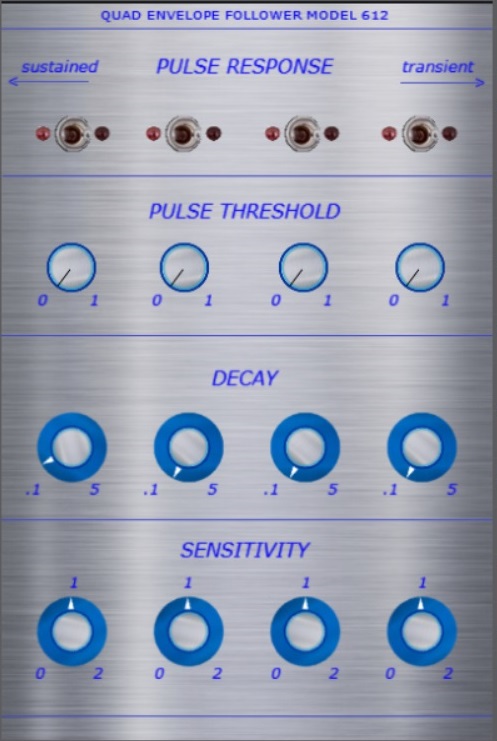
MODEL 612 is a quad envelope follower that converts the changing dynamics of four incoming signals into control gestures shaped for sustained or transient response.
Each lane combines pulse-response mode, threshold, decay and sensitivity. The result can follow broad amplitude contours, isolate articulations or generate four contrasting modulation streams from audio material. The module is particularly suited to sound-reactive synthesis and audiovisual interaction.
Instrument anatomy
Four readings of sonic energy
The repeated four-lane structure lets the same source be analysed in different ways or allows several sources to drive independent control paths.
Four detector lanes
Four independent channels extract control contours in parallel, preserving separate behaviour for instruments, frequency bands or spatially distributed sources.
Sustained response
A sustained setting favours the broader energy contour of a signal, useful for smooth following, long phrases and gradual changes in visual or synthesis parameters.
Transient response
A transient setting gives greater importance to attacks and short events, turning rhythmic articulation into triggers, pulses and sharply defined modulation.
Pulse threshold
Threshold determines the level at which a significant event is recognised, separating intentional articulation from background energy and low-level variation.
Decay
Decay controls how quickly the extracted envelope returns after activity, moving from short pulses toward longer, connected gestures.
Sensitivity
Sensitivity adapts each detector to its source, allowing quiet material and more energetic signals to occupy a useful control range without identical gain staging.
Responsive analysis without unstable control
The DSP path must balance fast detection with stable output. Threshold and decay changes require smoothing, while sensitivity scaling should preserve subtle dynamics without introducing chatter around the trigger point.
Let sound become its own controller
MODEL 612 can drive filters from instrumental intensity, extract rhythmic pulses from percussion, animate projections from live sound or create four differently paced responses from a single performance divided into frequency bands.
An envelope follower listens not for notes but for the way energy enters, remains and disappears.
MODEL 612 provides a bridge between acoustic behaviour and electronic response. By separating sustained and transient interpretations, the module acknowledges that the same sound can be read as a long gesture or as a sequence of events. Both readings become material for synthesis and image.
- Four independent envelope-following channels.
- Selectable sustained or transient response.
- Per-channel pulse threshold.
- Adjustable decay for short or connected gestures.
- Sensitivity control for different source levels.
- Audio-reactive synthesis, spatial and visual applications.