Instrument statement
Between continuous motion and captured state
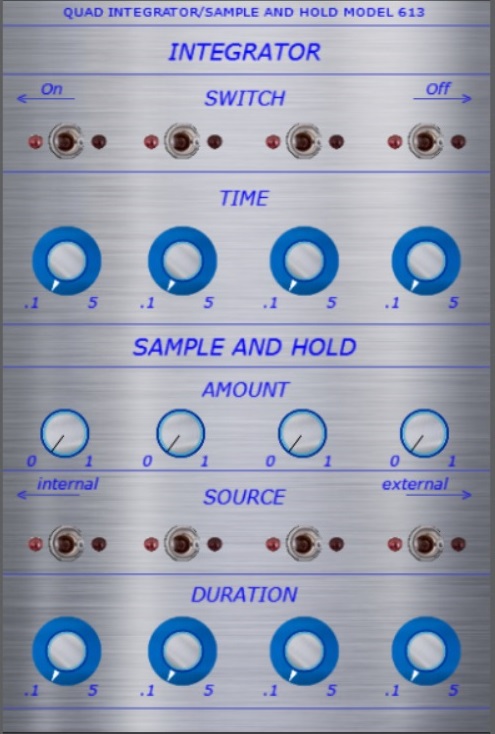
MODEL 613 combines four integrators with four sample-and-hold paths, allowing control signals to be smoothed, accumulated, captured and held inside one repeated architecture.
Each lane provides an integrator switch and time control followed by sample-and-hold amount, internal or external source selection and duration. The module can transform abrupt data into gradual motion or interrupt continuity by extracting a stable value from a changing source.
Instrument anatomy
Four paths through memory and continuity
The panel is divided into an upper integrator and a lower sample-and-hold section, making two complementary treatments of control information available in every lane.
Four independent lanes
Each channel can process a separate control signal or provide a different interpretation of the same source, producing related but distinct modulation streams.
Integrator switching
The upper switches activate or bypass integration per lane, allowing immediate comparison between direct control and accumulated, smoothed behaviour.
Integration time
Time determines how quickly the integrated output responds, moving from relatively direct following toward slow curves and extended transitions.
Sample amount
The amount control defines the influence of the sampled value, giving each lane a controllable balance between incoming motion and held state.
Internal or external source
Source selection lets the sampling event originate inside the module or arrive from another part of the system, supporting autonomous and synchronised use.
Hold duration
Duration controls how long the captured state remains active, turning rapidly changing input into stepped sequences, pauses or longer plateaus.
Reliable state changes and stable smoothing
The DSP implementation must keep integrator response sample-rate independent, handle source changes predictably and preserve sampled values without drift. Time and duration changes require smoothing so control remains stable during performance.
Shape the memory of a control signal
MODEL 613 can smooth sequencer steps, create portamento-like transitions, derive stepped values from continuous modulation or suspend a gesture long enough for it to become a structural musical state.
Control becomes expressive when it can both remember where it has been and decide when to stop moving.
MODEL 613 places continuity and interruption next to each other. Integration gives a signal inertia; sample-and-hold gives it memory. Combining those behaviours across four lanes creates a vocabulary of curves, plateaus and delayed decisions that can organise sound or image.
- Four independent integrator and sample-and-hold paths.
- Per-lane integration switching and response time.
- Adjustable sample amount.
- Internal or external sampling source.
- Controllable hold duration.
- DSP translation focused on stable state and timing behaviour.