Instrument statement
Four sound sources moving through a shared space
MODEL 614 is a four-source spatial director conceived for quadraphonic and octaphonic loudspeaker systems. Each source has an independent position, level and movement strategy.
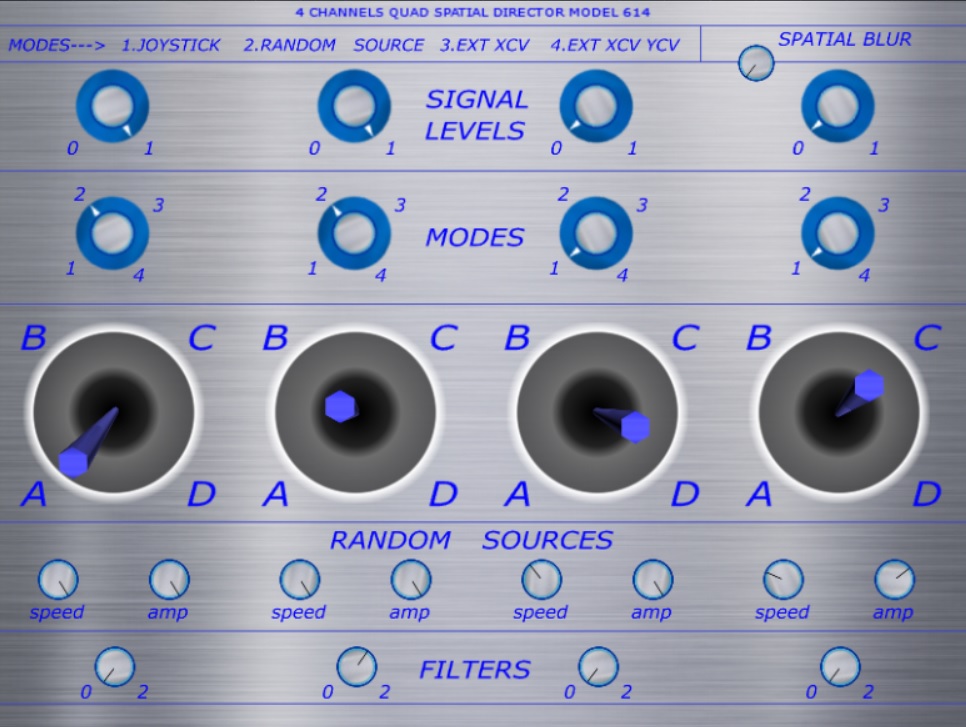
Four XY fields place sources between spatial nodes A, B, C and D. A mode selector chooses joystick control, autonomous random motion or external X/Y control voltages. Speed, amplitude and filtering shape the random paths, while spatial blur distributes each source beyond a single precise point.
Instrument anatomy
Spatial movement as instrumental control
The panel presents four parallel spatial voices, each with position and motion behaviour, while global blur expands the perceived footprint of the complete scene.
Four signal levels
Independent level controls establish the contribution of each source before its position is distributed through the loudspeaker field.
Four spatial modes
Each source selects joystick, random motion, external X control or external X/Y control, allowing manual, autonomous and data-driven trajectories to coexist.
XY spatial fields
The large A–D fields provide an immediate map of source position and make multichannel placement readable as a geometric performance gesture.
Random speed and amplitude
Autonomous trajectories have independent speed and amplitude controls, producing anything from restrained drift to wide and rapid movement.
Motion filtering
Per-source filtering smooths or reshapes generated movement so spatial paths can remain fluid rather than reproducing every abrupt control change.
Spatial blur
Spatial blur broadens localisation, placing a source across a region of the loudspeaker field instead of fixing it to one narrowly perceived coordinate.
Multichannel gain trajectories without discontinuity
The DSP version must calculate smooth gain distributions for quadraphonic and octaphonic layouts, preserve energy while sources move and avoid clicks when modes or external control sources change.
Compose trajectories, not only positions
MODEL 614 can spatialise four instrumental voices, create independent orbiting layers, map audiovisual data to sound position or combine performed joystick movement with autonomous random paths in an installation.
Spatialisation becomes musical when movement has phrasing, inertia and a recognisable relation to the sound it carries.
MODEL 614 treats the loudspeaker field as an instrument rather than an output format. Each source can be placed, performed or allowed to move autonomously, while spatial blur questions the assumption that localisation must always be precise.
- Four independently controlled spatial sources.
- Support for quadraphonic and octaphonic layouts.
- Joystick and external X/Y control.
- Autonomous random trajectories.
- Per-source speed, amplitude and motion filtering.
- Spatial blur for distributed localisation.