Instrument statement
Designing an acoustic fiction from reflections and material
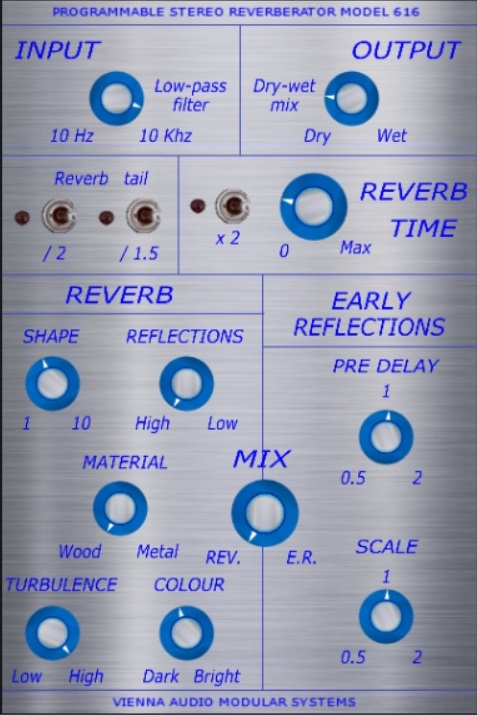
MODEL 616 is a programmable stereo reverberator that treats the reverberant tail and early reflections as distinct but interacting components of an imagined space.
Input filtering and dry/wet output control frame a reverb section with time, tail scaling, shape, reflection character, material, turbulence and colour. Early reflections have their own pre-delay and scale, while the central mix determines the relationship between the first spatial cues and the later diffuse field.
Instrument anatomy
A reverberant space assembled in layers
The interface separates the input, output, late reverb and early-reflection stages so that spatial size and surface character can be shaped independently.
Input low-pass filter
The input filter determines how much high-frequency energy enters the reverberator, affecting brightness, density and the persistence of the resulting field.
Dry/wet output
A dedicated output mix controls the global relation between direct signal and complete reverberated response.
Tail and reverb time
Tail scaling and reverb time establish the duration and growth of the late field, from compact ambience to extended resonant space.
Shape and reflections
Shape changes the temporal profile of the reverb, while the reflections control shifts the early energy between brighter and darker behaviour.
Material, turbulence and colour
Material moves between wood-like and metal-like character, turbulence changes internal irregularity, and colour spans darker to brighter responses.
Early-reflection timing
Pre-delay and scale establish the apparent distance and dimensions of the virtual space, while the reverb/early-reflection mix defines its perceptual balance.
Spatial density with controlled energy
The DSP implementation must maintain stable feedback, diffuse stereo decorrelation and smooth changes in time, scale and colour. Delay modulation and filtering require careful interpolation to avoid clicks and uncontrolled level growth.
Build spaces that behave like instruments
MODEL 616 can create compact rooms, metallic resonant chambers, dark distant fields or unstable spaces whose material and turbulence evolve during a performance. Early reflections can remain explicit or dissolve into the tail.
Reverberation is not only the trace of a room; it can be the active construction of a place that never existed.
MODEL 616 uses spatial language such as material, scale and colour to keep technically complex behaviour connected to perception. The performer does not simply select a preset environment but composes how a space begins, spreads and decays.
- Independent treatment of early reflections and reverb tail.
- Input filtering and global dry/wet control.
- Reverb time, shape and tail scaling.
- Material, turbulence and tonal colour.
- Pre-delay and scale for virtual dimensions.
- DSP translation focused on stable, smooth spatial processing.