Instrument statement
Three delay lines with independent temporal identities
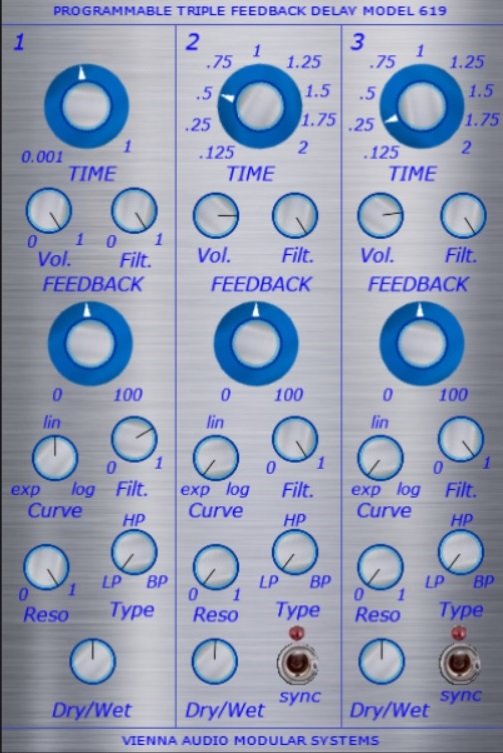
MODEL 619 is a programmable triple feedback delay in which three parallel lines can occupy different time scales, filtering behaviours and feedback trajectories.
Every lane provides delay time, feedback volume, feedback filtering, total feedback, curve, filter amount, resonance, multimode filter type and dry/wet balance. The second and third paths also offer synchronisation, allowing freely tuned echoes and related rhythmic structures to coexist.
Instrument anatomy
A network of echoes rather than one repeated event
The three columns share a control grammar but use different time ranges, encouraging short detail, longer repetition and synchronised rhythm to interact.
Three delay times
The first lane reaches very short values while the other two extend toward longer echoes, supporting flanging-like detail, rhythmic repetition and layered temporal depth.
Feedback volume
Feedback volume sets how strongly the returning signal re-enters each line, from a single echo to extended regenerative structures.
Feedback filtering
Filter amount, resonance and low-pass, high-pass or band-pass type reshape every repetition, allowing echoes to darken, thin out or become resonant over time.
Feedback amount
The large feedback controls determine the persistence and energy of each delay path, making careful gain staging part of the instrument's performance.
Response curve
Linear, exponential and logarithmic curve control changes how each feedback structure develops, affecting the perceived acceleration and decay of repeated material.
Dry/wet and synchronisation
Independent dry/wet controls place each line in the output mix, while sync on lines two and three establishes repeatable relationships with a common timing source.
Regeneration with safe and musical control
The DSP version must interpolate delay-time changes smoothly, prevent unstable feedback growth and update filters inside each feedback loop efficiently. Synchronised timing should remain coherent while free-time controls stay performable.
Construct rhythm from overlapping memories
MODEL 619 can generate multitap rhythmic patterns, filtered dub-like repeats, resonant delay textures or three contrasting temporal layers. Very short times add spectral colour while longer paths create recognisable echoes and formal recurrence.
A delay becomes compositional when every repetition can age differently and each memory occupies its own scale of time.
MODEL 619 treats echo as a three-part temporal system. Repetition is shaped by filtering, response curve and regeneration rather than copied unchanged. The three paths can agree rhythmically or remain deliberately misaligned, producing motion from their interference.
- Three independent feedback-delay lines.
- Different time ranges for detailed and extended echoes.
- Per-line feedback level and filtering.
- Linear, exponential and logarithmic response curves.
- Multimode feedback filters with resonance.
- Free and synchronised temporal relationships.