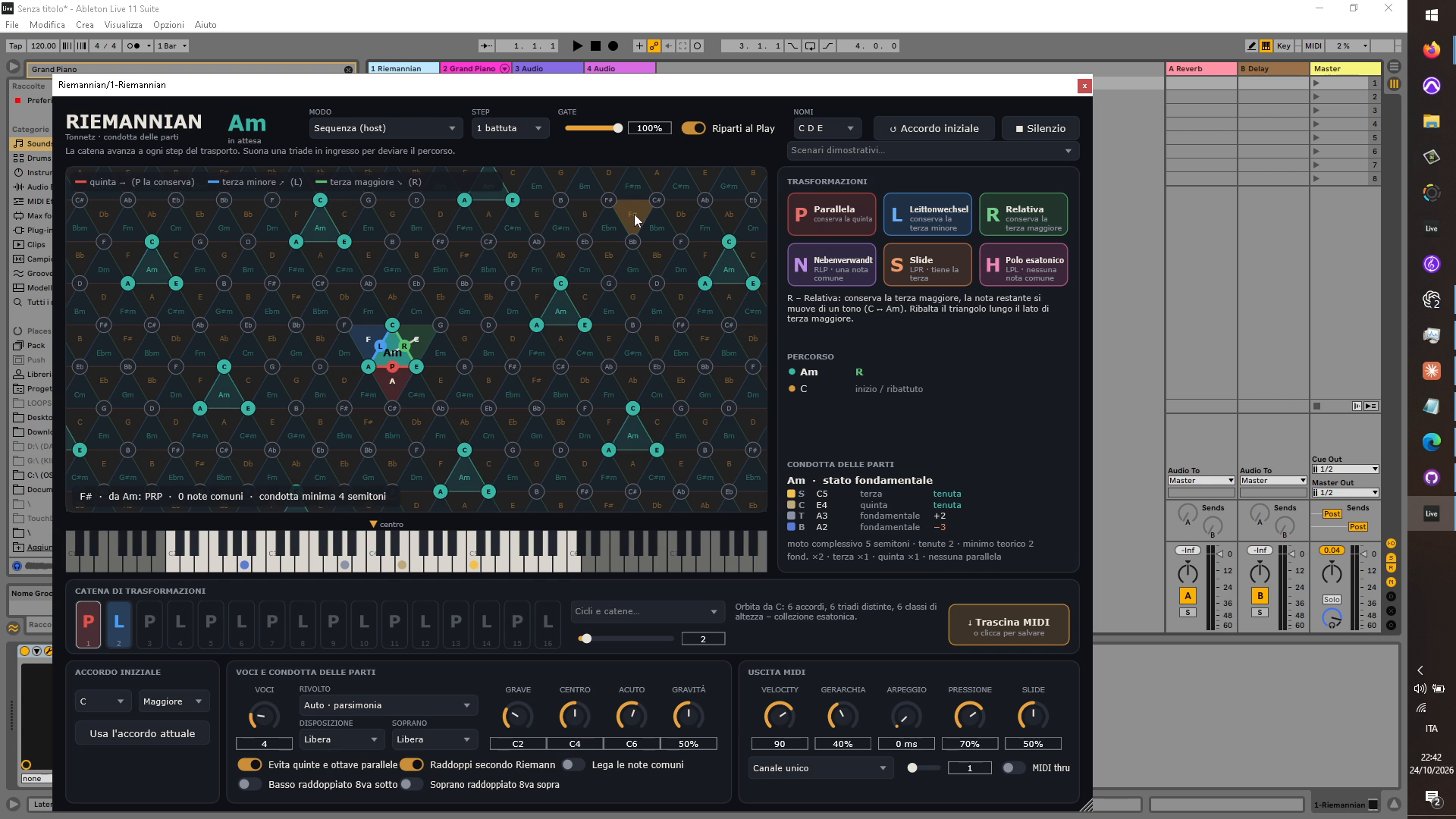
Harmony instrument / VST3
A playable map of harmonic proximity
Riemannian is a MIDI-generating VST3 and standalone instrument that turns the Tonnetz into a performable environment for Riemannian and neo-Riemannian harmony.
The project treats harmonic theory as an active musical space. Major and minor triads can be transformed through P, L and R or through the compound operations N, S and H. A path can be advanced from the host transport, triggered from MIDI, played from a transformation keyboard or explored manually on the Tonnetz.
System anatomy
From abstract transformation to real voices
The Tonnetz describes relations between pitch classes; the voice-leading engine translates those relations into playable registers, inversions and instrumental parts.
Interactive Tonnetz
Every triangle represents a major or minor triad. Adjacent triangles expose the P, L and R transformations, while any other triad can be reached through a shortest path across the graph.
Transformation chain
A sixteen-step chain combines P, L, R, N, S and H into recurring harmonic orbits. Presets include hexatonic, octatonic and all-triad cycles, and the full orbit can be dragged into the DAW as MIDI.
Four performance modes
Sequence mode follows the host transport; Trigger mode advances from incoming notes; Transformation Keyboard maps operations to MIDI keys; Manual mode responds to the interface and played triads.
Voice-leading engine
Each triad is realised across three to eight real voices. The system searches admissible voicings while considering common tones, melodic motion, spacing, register, doubling and parallel fifths or octaves.
Voicing controls
Automatic parsimonious or functional-bass modes can be combined with fixed inversions, close or open spacing, soprano position, octave reinforcement, held common tones, hierarchy and arpeggiation.
DAW integration
In Ableton Live the plugin is loaded as an instrument that produces MIDI rather than audio. Its output is routed to another track, where any instrument can render the generated harmony.
Harmony as gesture and trajectory
Riemannian can produce compact transformations, slowly evolving harmonic fields, cyclic progressions and abrupt changes of tonal region. The same path can be heard through piano, ensemble writing, synthesis or a multi-channel orchestration of the individual voices.
Theory checked in code
The current core test suite completes 8,720 checks covering elementary and compound transformations, cycles, graph paths, Tonnetz geometry, admissible voicings, long progressions and register behaviour.
The Tonnetz becomes interesting when it stops being a diagram and starts behaving like an instrument.
Riemannian was developed to keep theory, gesture and listening in the same frame. Transformations remain visible, but every abstract operation must also become a convincing movement between real voices. The result is a compositional tool that can be analytical and immediate at once.
Video tutorial
Riemannian in Ableton Live
The tutorial presents MIDI routing, Tonnetz navigation, transformations, voice leading, sequences, drag-and-drop MIDI and performance modes. Narration and captions are in Italian.
- Interactive neo-Riemannian Tonnetz.
- Six elementary and compound harmonic transformations.
- Shortest-path navigation between all major and minor triads.
- Automatic voicing from three to eight parts.
- Host, MIDI, keyboard and manual performance modes.
- MIDI export and routing for external instruments.