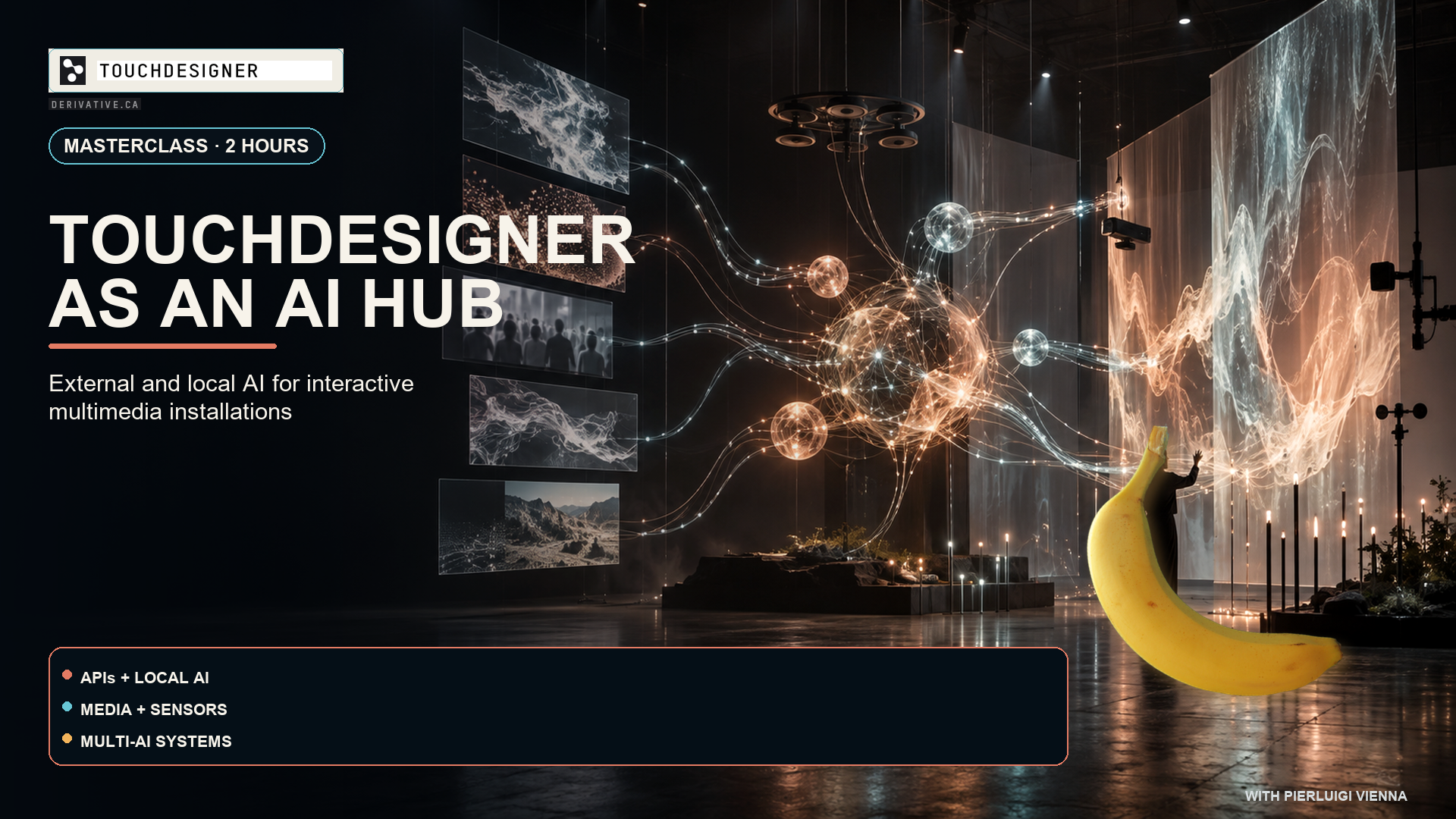
Masterclass overview
From a single AI tool to a coordinated audiovisual system
TouchDesigner becomes an orchestration environment that acquires signals, prepares requests, manages asynchronous services and translates model responses into image, sound, light and interactive behaviour. The masterclass connects APIs, local models, sensors and creative software while keeping the real-time graphics loop separate from model inference.
Programme
A 120-minute system map
The session moves from protocols and service categories to complete multi-AI architectures, reliability and responsible deployment.
TouchDesigner as a hub
Separation between the real-time loop, AI services and devices; the roles of TOP, CHOP, DAT and COMP families.
Inputs and protocols
Camera, audio, sensors, OSC and MIDI together with HTTP requests, WebSocket, JSON and media transfer.
Generative APIs
Services producing images, video, voice, music and synchronised audio from text, images or moving image.
Media analysis APIs
Poses, objects, shots, transcription, diarisation, topics, segments and semantic search as control information.
Local AI
Private data, portable weights and dependencies, controlled adaptation and operation without a web connection.
Multi-AI installations, reliability and ethics
Queues, timeouts, fallbacks, provenance, consent, manual stop and architectures built around verifiable model roles.
Who can take part
- Basic familiarity with TouchDesigner is recommended but not mandatory for conceptual participation.
- Some experience with audiovisual systems, creative coding or interactive media is useful.
- No advanced programming knowledge is required.
What to bring
- A laptop with TouchDesigner installed for participants following the demonstrations.
- A stable internet connection for online delivery and cloud-service examples.
- Headphones; optional microphone, webcam or MIDI controller.
- API accounts are optional: demonstrations can be followed without purchasing services.
- A clear distinction between rendering, inference and device-control timescales.
- A protocol map for data, control and large media.
- A modular architecture for cloud and local AI services.
- Strategies for queues, timeouts, fallbacks and manual interruption.
- Methods for documenting models, prompts, timing and provenance.
- Reference scenarios for installations, archives and audiovisual performance.